
Use Weber County’s Voter Lookup
The official Vote.Utah.gov Check My Status tool is the first channel for an individual Weber County voter. It verifies the person behind the request before returning registration and polling information. It is meant to answer a personal election question, not to let someone browse every voter who shares a surname. Protected and At-Risk voters can use it to see their own information as well.
Enter the identity details requested by the live form. The embedded vendor can change its visible labels, so the table describes the verified input categories rather than claiming wording the static state page does not expose.
| Lookup input | Control | Required | How it is used |
|---|---|---|---|
| Name and identity details | Text | Yes | Matches the voter’s own record |
| Date of birth | Date | Yes | Verifies identity and is not released publicly |
| Address details | Text | As prompted | Supports the registration match |
| Look up status | Button | Action | Returns a match or correction guidance |
If the result seems wrong, use the correction guidance or contact Weber County Elections. A missing match is not proof that no registration exists. Spelling, a recent move, withheld identifying data, or a pending update can affect what appears.
Two Weber County Voter Channels
Utah draws a firm line between checking one’s own voter registration and ordering a public list. Check My Status confirms a voter’s registration and polling details after identity inputs. A public researcher who needs a countywide dataset must request a file instead. Weber County or district subsets go to the Weber County Clerk/Auditor; the Lieutenant Governor’s office sells only the statewide database.
The Weber County Clerk/Auditor is at 2380 Washington Boulevard, Suite 320, Ogden, Utah 84401. The office can be reached at 801-399-8400 or by fax at 801-399-8300. Standard county hours are 8 a.m. to 5 p.m. on weekdays, excluding holidays. These phone, fax, and counter channels matter when the self-lookup cannot resolve a Weber County record or when the requester needs a local extract.
Note: Ask the Clerk/Auditor for the current county-list fee because the inspected official pages did not publish one.
Fields in Weber County Voter Records
A public Utah voter record can identify a Weber County elector and connect that registration to election geography. The file is much broader than a polling-place answer, but it does not reveal how anyone marked a ballot. Field definitions matter because a mailing address may differ from a residence and a registration update is not always the original registration date.
| Identity | Full legal name, voter ID number, county, and age range |
|---|---|
| Addresses | Residential address and unit plus mailing address and city, unless protected |
| Election geography | Precinct and congressional, legislative, school-board, county-council, and city-council districts |
| Registration details | Party or unaffiliated status, active or inactive status, and last registration update |
| Vote history | Elections in which the voter participated, never candidate or ballot choices |
The public-file inventory comes from the state’s voter and election data request page. Treat each field for what it says. District assignments follow the residence and its geocode. Party status can change, and unaffiliated is a distinct status rather than an inference about political views.
Private Data in Utah Voter Records
Utah’s public classification does not open the whole registration form. The official voter privacy rules distinguish fields that are always protected from identifying data that is normally public but may be withheld for an At-Risk voter. Utah Code Sections 20A-2-601 and 20A-2-602 govern the core classifications.
Confidential by Utah law. Full birth dates, driver or state ID data, Social Security numbers, signatures, email addresses, and phone numbers are not part of the public voter file. At-Risk status can also withhold identifying fields.
Age range is intentionally less exact than date of birth. Do not try to reconstruct a protected birth date by pairing the range with outside data. A public Weber County voter record should be read as the law supplies it, with privacy omissions left intact. Possible consent-based sharing of email or phone with political parties does not begin until January 2027.
Weber County At-Risk Voter Protection
Utah’s strengthened At-Risk classification can protect eligible people whose voter information could put them in danger. The categories include victims of domestic or dating violence, threatened people, law-enforcement officers, those covered by protective orders, armed-forces members, public figures, and qualifying household members. Utah Code Section 20A-2-104 and SB 153 supply the framework.
The protection limits public disclosure; it does not erase Weber County’s official registration. Government entities may still use the data for authorized duties, and aggregate information can remain available. The application uses a full name, address or birth date to locate the record, contact details, an eligibility basis with support, and a signed attestation.
A withheld entry is not a “missing voter.” It is a voter record receiving the disclosure limits the state approved. Never publish a protected address or use public data to defeat a protective order or address-confidentiality safeguard.
Request Weber County Voter Rolls
Choose the custodian by geography. A Weber-only or district list belongs with the County Clerk/Auditor. A request for all Utah counties uses the state order system. The statewide database costs $1,050 as a one-time purchase, with no refund, subscription, or free updates. It arrives through an emailed download link, generally within one business day.
- Define the requested geography, snapshot date, and whether active-only or active-and-inactive registrations are needed.
- Ask for the standard public field layout and its data dictionary. Confirm the current fee, payment method, file type, extract date, and delivery method.
- For statewide data, complete the online product and contact fields, submit payment, acknowledge the access terms, and save the emailed file promptly.
The statewide voter registration file is tab-delimited and about 150 MB. Utah warns that common spreadsheet software may not display all of it. That is a software limit, not evidence that rows are missing. Keep the supplied data dictionary so voter ID, district, status, and update fields are not misread.
General government-record procedure is covered separately in the Weber County public records access reference. The specialized voter-file product and its statutory exclusions remain the right route for voter rolls.
Utah’s 2026 Voter Snapshot Pause
Freshness has an unusual legal limit in 2026. Utah Code Section 20A-2-607 bars distribution of current voter-registration information until May 25, 2026. Requests made during that interval receive a March 8, 2026 snapshot. A file delivered on a later date can therefore omit moves, new registrations, and status changes made after the snapshot.
The restriction is a timed distribution rule, not a statement that every Weber County registration stopped changing. Record the extract date alongside any analysis. Once the pause ends, confirm which snapshot the office will supply before paying or comparing files.
The state voter-data request screen shows the product choices and the controls a buyer uses. See the official Utah voter-data source represented here:
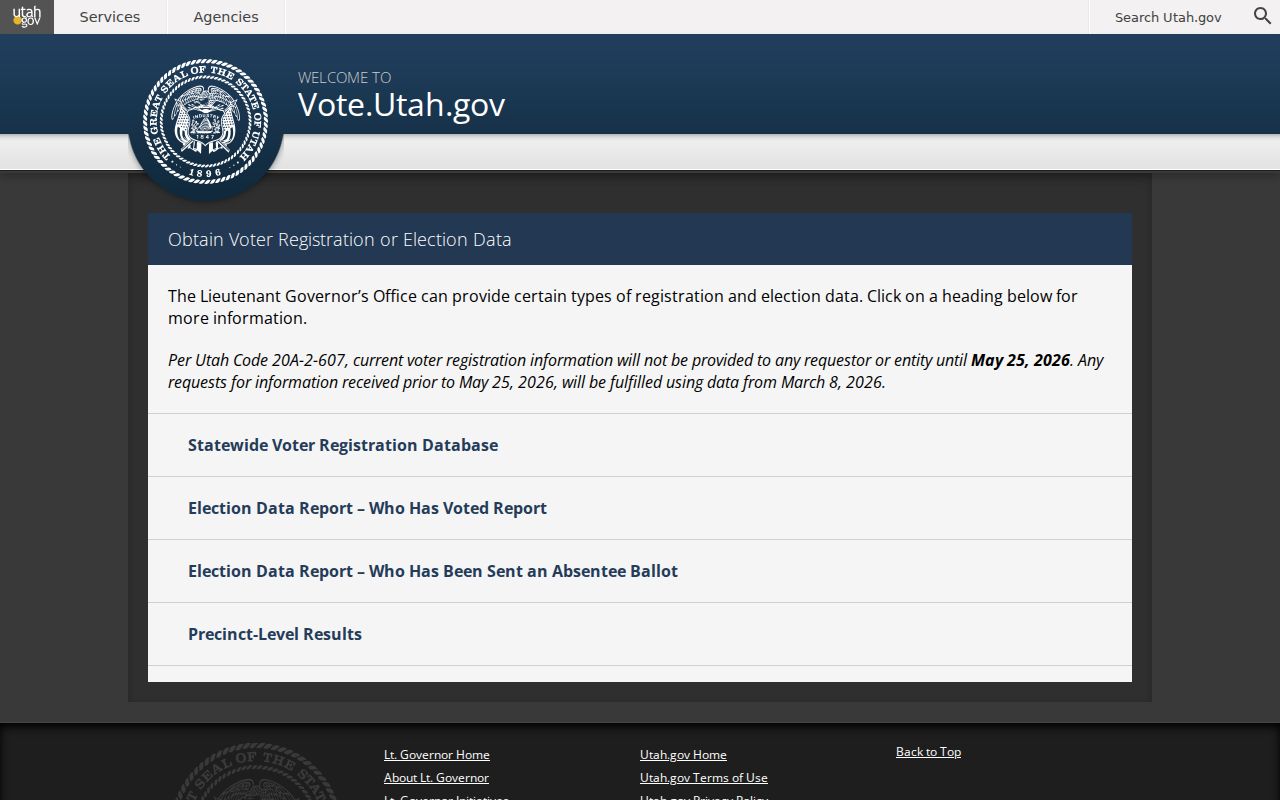
The screen helps separate the full database from election-period reports before a requester enters contact, payment, and delivery information.
Note: During the statutory pause, state the March 8 snapshot date whenever Weber County voter data is quoted or compared.
Reading Weber County Voter Status
“Active” is an administrative registration status, not proof that a person still lives at the listed residence. Mail can become undeliverable before the file changes. Utah defines an inactive voter through a specific sequence: the person did not vote in two regular general elections and did not respond to a clerk notice. Inactive does not mean unregistered.
The state’s NVRA maintenance reports publish monthly confirmation-card, returned-confirmation, and removal information for two years. Removal reasons include death, inactive status, and the voter’s own request. These reports explain maintenance activity in totals; they are not a substitute for a person’s Check My Status result. Utah also publishes current and historical registration statistics separately.
The official self-service gateway is the safest place for a Weber County voter to resolve personal status. The Vote.Utah lookup source shown below directs voters toward registration and polling information:
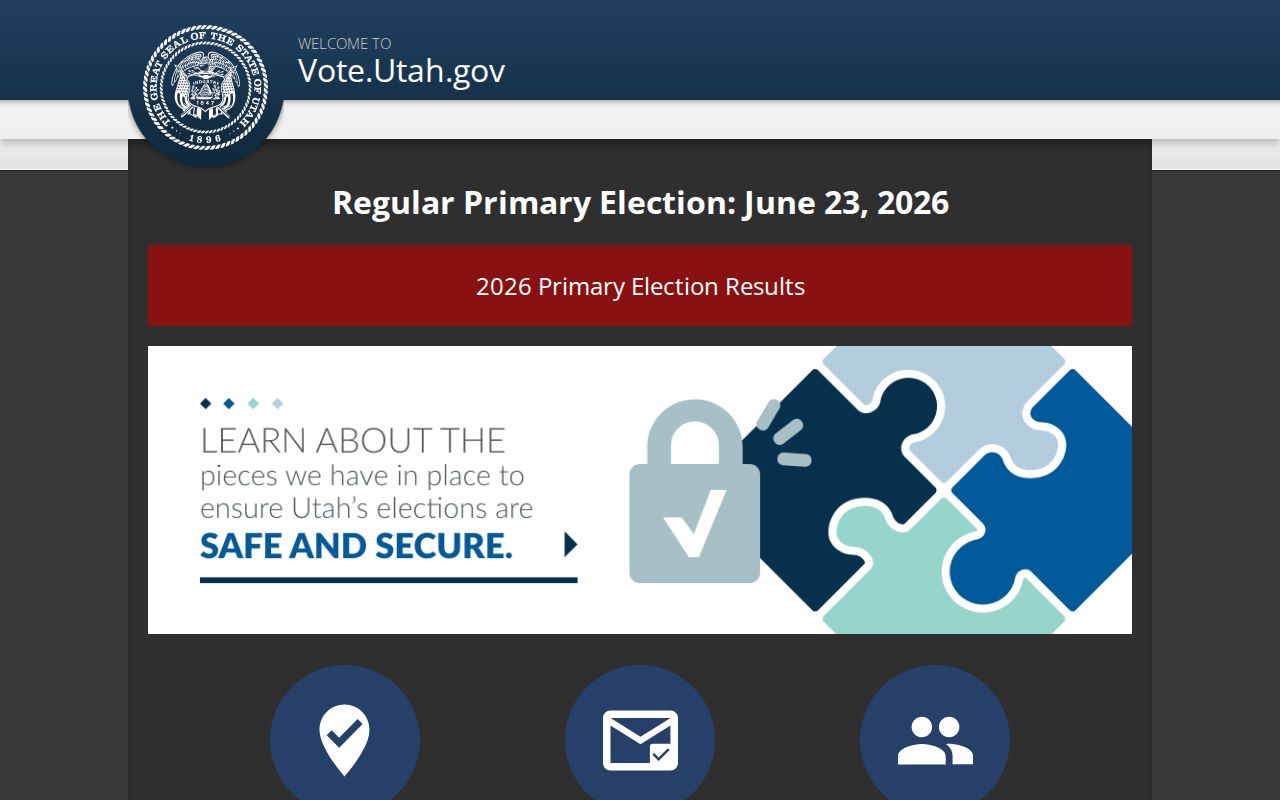
Its identity-based flow preserves the difference between personal verification and public-file access.
Weber County Vote-Activity Reports
Utah offers two $35 election-period products for eligible regular even-year elections. The “Who Has Voted” report identifies participation method and ballot processing date. The “Sent an Absentee Ballot” report reflects ballot-order creation and processing information. Neither reveals a selection on the ballot.
| Product | What it answers | Delivery window | Cost |
|---|---|---|---|
| Who Has Voted | Who participated, method, and processing date | Daily, from 21 days before Election Day through the day before | $35 per eligible election |
| Sent an Absentee Ballot | Ballot-order creation and processing information | Same even-year election window | $35 per eligible election |
| Precinct results | Aggregate election results, not voter identities | Separate product | No fee |
The two paid reports are unavailable during odd-year municipal elections and after the election. Private records are excluded or anonymized as the state describes. Name the election and product precisely when ordering; asking for “vote history” alone can blur three very different datasets.
Historic Weber County Voter Registers
Current downloads are only one form of the record. Utah retains registration records permanently under state series 28818. For older Weber County elections, search the Utah State Archives city and county catalogs for Clerk election records, registration registers, poll lists, and canvasses. The catalog is organized by the agency that created the material.
Ask the Archives reference desk for a series by record type and date. The researched official guide did not establish exact coverage years for Weber County poll books, so do not assume a continuous run or assign years without catalog confirmation. Older registers may also survive in a different format from today’s tab-delimited file.
Permanent retention does not cancel current privacy classifications. Historical value and present access are separate questions, and the custodian applies the rules in force when responding.
Lawful Use of Weber Voter Data
Public access never grants permission to stalk, threaten, harass, impersonate, or expose a person protected by law. Utah criminal statutes, protective orders, and civil remedies apply apart from the records classification. Keep universally private fields private, honor At-Risk omissions, and report suspected voter-data misuse to the Weber County Clerk or the Lieutenant Governor’s elections office.
Use voter records with care. Verify status with the proper custodian, never infer ballot choices from participation, and do not republish information to harm or locate a protected person.
Context prevents false claims. A registration address is not certain proof of current residence. Inactive status is not cancellation. An update date may not show when the voter first registered or moved. Used within those limits, Weber County voter records support civic review and historical research without turning administrative data into conclusions it cannot prove.